Frontman for the miscellany band Camper Van Beethoven, once wan and thin and Shelleyesque, now bearded, thick, and grungy, David Lowery roams the planet as a latter-day rhapsode, the sort Socrates hails as a magnet in the Ion, a book I read many years ago and about which I remember next to nothing, save that poets are magnets. (By consensus classicists date Ion as an early dialogue, mostly on the evidence that it sucks and ought to be better. If you've read any of Plato's works, you know that most of them climax, if at all, with a kind of mutual shrug and agreement to walk to the next grove or temple or flower shop to ask other loiterers to define Justice for them. But the poor stiffs in the Ion don't even get that far; like victims of some unthinkable inversion of an Outer Limits episode, they loop through the same argument, over and over, until Socrates, cracking, nearly falls to his knees and blames Jesus for poetry. I'm happy not to remember more of it, and I'm pretty sure that the only part I do recall, the part about magnets, brings more to my life with its sheer absurdity than it steals from it with gibberish.) Lowery's particular genius lies, like Ion's, in insisting on his humanness, when others would make him an oracle. Poor Ion suffers his Socrates, who calls him a vessel for the gods and therefore, technically, unskilled. Lowery, by contrast, has both his critics, who call him an ironist's marionette, and his fans, who believe them. And they have a reason to. Lowery's songs are miniature madhouses, where everything, even the humorless, gets joked at and mutilated. Through three decades, his records have kept a reliable tone, something like a doomsday nonchalance. Those captivated by it, usually the young and pompous, swoon to lines like these from the song "Jack Ruby":
I remember his hat tilted forward
His glasses are folded in his vest
And he seems like the kind of man who beats his horses
Or the dancers who work at a bar
His glasses are folded in his vest
And he seems like the kind of man who beats his horses
Or the dancers who work at a bar
Smug. Coy. Pissy. Almost clever (but not). Everyone clutching a copy of The Bell Jar, from Portland to that other Portland, adds him to the wonderlist where genuine killers like Nietzsche and Rimbaud contend with shitbirds like Jim Morrison. But irony, which the kids love, isn't the only trope operating there, and, on a closer listening, it isn't even the dominant one. Hence the cunundrum. It's an unfair fact of Lowery's career that his most widely disparaged trait--his aptitude for non-sequiturs, roundabouts, and aposiopeses--also makes him an honest-to-god heavyweight, despite the general smarminess of his fans, because, contrary to the conclusions of both his fans and his critics, he isn't an ironist; he's a realist who uses irony to make us feel fragile.
Consider again "Jack Ruby," which opens as an excuse for spinning nonsense and digging rhetorical holes for the listener to fall into; it's a joke song, a lark. But, imperceptibly, the song sheds the perspective of the hyperaware, Baudrillard-laden brain contemplating its own contemplation of history becoming history (smartass), and picks up the more material questions of what that kind of history looks and feels and hurts like, only, finally, to disappear under consequences, submerged beneath the liquid vacuum of disconnection and departure. Stranded there, a gratuitous conscience barraged by games and allusions and quips, the speaker suddenly knows that it's all very small and sordid, and that he craves closeness. The song unravels quietly into a dirge, whose stakes really are life and death:
Now do you feel that cold, icy presence?
In the morning with coffee and with bread
Do you feel it in the movement of traffic
And days are terrible, simply forget.
In the morning with coffee and with bread
Do you feel it in the movement of traffic
And days are terrible, simply forget.
Echoes of Prufrock? The admonition to "simply forget" is abrupt, but correct, too, given the song's ludic beginnings and its transformation into dangerous self-knowledge. In fact, that very gruffness only intensifies the irreversibility: what's been learned can't be unlearned, and the cool ironies of the first lines reflect back to us like breath evaporating on glass. Unable to reconstruct the person from traces, or contact from memories of being close, or energy from intelligence, we end the song in a state of self-defeat. There's nothing to do but forget, when forgetting is just another useless tool in an ironist's toolkit. When appraised as a whole, and not sampled as an archive of catchphrases and throwaways, "Jack Ruby" looks less like a snide scavenging of scandal than a poignant warning against that very temptation.
But looking back, surveying the changes, it's difficult to find a hinge on which the argument turns. All seems to merge and divide like cells reproducing and then reabsorbing one another. The plunge from masturbatory cant to dreadful introspection is surprisingly subtle. And I think that's the quality that insulates David Lowery's songwriting from the over-familiar or the over-smart: subtlety. His irony is always aware of its cost: remoteness. In that respect, what distinguishes Lowery from other hot-penned pedants of his generation--I won't drop names, although I have a few in mind--is the candid auditing of his own method, which, like a grim ecclesiast, he administers deftly but also regretfully. His talent is the old actor's, who plays his part expertly--so expertly that he seems, to all but the keenest appreciator, to relish it--but who reveals to the quick-eyed and the caring, through the slightest twist of the lips, his disgust for the role that made him famous.
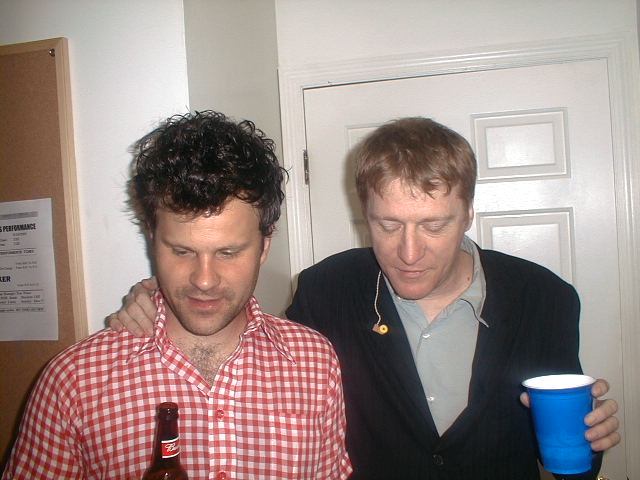 |
| Lowrey to friend: "I got some certain special feelings for you." |

No comments:
Post a Comment